
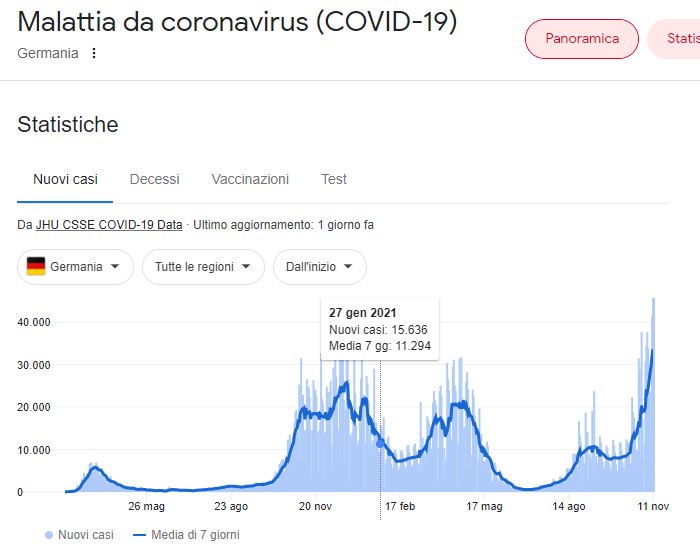
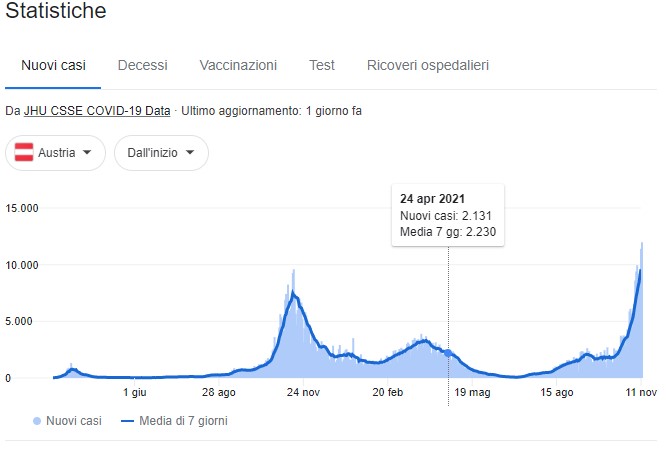
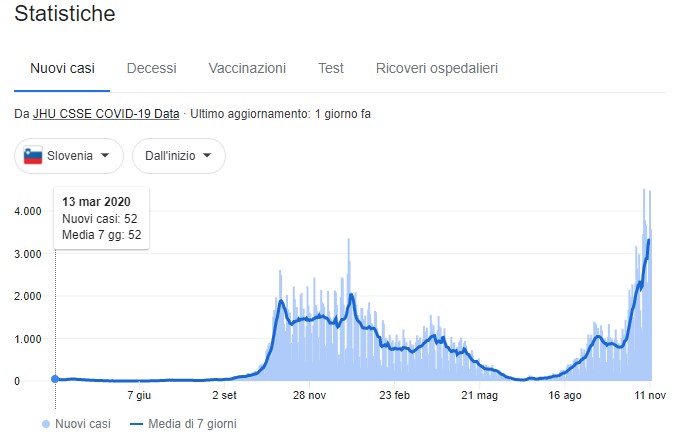
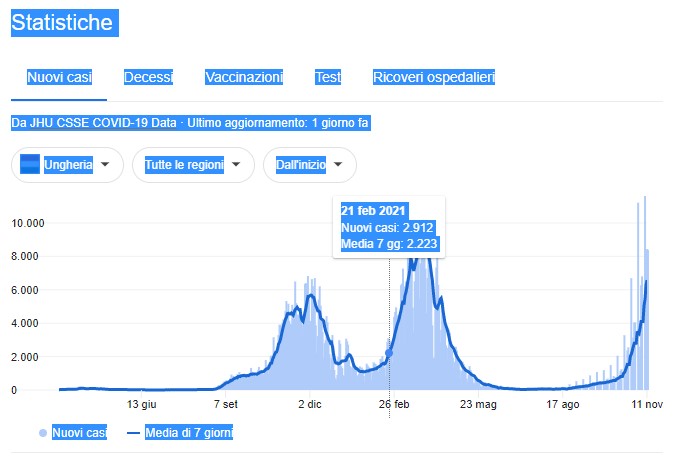
Dai dati aggiornati all’11 novembre e’ lampante che la pandemania dalla Variante Delta e’ in pieno sviluppo in:
GERMANIA, AUSTRIA, CECHIA, SLOVACCHIA, UNGHERIA, SLOVENIA, CROAZIA
Fondamenti logici della filosofia, filosofia della scienza, rapporti con la teologia
Matt 16:13-19
In illo témpore: Venit Iesus in partes Cæsaréæ Philíppi, et interrogábat discípulos suos, dicens: Quem dicunt hómines esse Fílium hóminis?
Oggi commemoriamo San Martino I (Todi, 600 circa – Cherson, 16 settembre 655) papa e martire eletto papa della Chiesa cattolica dal luglio 649 alla sua morte, venerato come santo dalla Chiesa cattolica e dalle Chiese ortodosse.
Durava da molti anni la controversia tra Santa Sede e l’imperatore bizantino (spalleggiato dal patriarca di Costantinopoli) sul problema delle volontà di Cristo. E’ il cosiddetto conflitto sul monotelismo. Secondo queste eresia veniva negata la doppia natura divina e umana di Gesu’ Cristo. La controversia era rimasta senza soluzione fino a quel momento. Uno dei primissimi atti ufficiali di Martino fu la convocazione, subito dopo la sua elezione, di un sinodo (il primo concilio Lateranense, il primo anche ad essere stato indetto senza l’autorizzazione dell’imperatore), per contrastare l’eresia monotelita. Ma l’imperatore subito dopo il concilio lo fece incarcerare ed esiliare in Crimea dove mori’ martire.
I papi della tradizione hanno affrontato al prezzo della loro vita la difesa del Depositum Fidei. Ora il falso papa tradisce ogni dogma e insegnamento di Cristo, mentre il vero papa, Benedetto XVI, sta subendo un lento martirio.
Dobbiamo pregare per lui, vittima della Chiesa, facendogli giungere il nostro amore e devozione.
Sia lodato Gesu’ Cristo! Sempre sia lodato!
____________________
(*) Questo commento e’ scritto in tempo reale durante l’omelia. Mi scuso per l’eventuale misinterpretazione delle parole di Don Enrico.
Matt 16: 13-19 In illo témpore: Venit Iesus in partes Cæsaréæ Philíppi, et interrogábat discípulos suos, dicens: Quem dicunt hómines esse Fílium hóminis?
Today we commemorate St. Martin I (Todi, about 600 – Cherson, 16 September 655) pope and martyr elected pope of the Catholic Church from July 649 to his death, venerated as a saint by the Catholic Church and the Orthodox Churches.
The controversy between the Holy See and the Byzantine emperor (backed by the patriarch of Constantinople) over the problem of Christ’s will lasted for many years.
It is the so-called conflict over monothelism. According to these heresy, the double divine and human nature of Jesus Christ was denied.
The controversy had remained unresolved until then. One of Martin’s very first official acts was the convocation, immediately after his election, of a synod (the first Lateran council, also the first to be held without the authorization of the emperor), to counter the Monothelite heresy.
But the emperor immediately after the council had him imprisoned and exiled to the Crimea where he died as a martyr.
The popes of the tradition faced the cost of their lives by defending the Depositum Fidei.
Now the false pope is betraying every dogma and teaching of Christ, while the true pope, Benedict XVI, is undergoing a slow martyrdom.
We must pray for him, victim of the Church, making our love and devotion reach him.
Praised be Jesus Christ! Always be praised!
________________
(**) This document is written in real time while the homily is taking place. I escuse myself for any possible misinterpretation of the words by Don Enrico.

Source LifeSiteNews: permission of reproduction pending
Thu Nov 11, 2021 – 3:01 pm EST
JERUSLAEM (LifeSiteNews) — Israel has carried out a national COVID drill Thursday in preparation for a potential new COVID-19 variant.
The “Omega drill” was named after a fictitious COVID strain. It was announced yesterday on the official website of the Israeli government, and held today at Israel’s National Management Center in Jerusalem; a blast-proof war-bunker designed for the management of nationwide crises.
The drill was led by Israeli Prime Minister Naftali Bennett, who said it was intended to prepare Israel “for any scenario.”
It took the format of three war-game like sessions designed to simulate the passage of time between various scenarios, including lockdown and quarantine measures, the closure of schools, gathering restrictions, curfews, mass-testing, vaccine booster campaigns, etc.
Bennett explained the aim of the exercise in a statement published yesterday on the Israeli government’s website. He said the epidemiological situation in Israel is now better than in the rest of the world.
“We’re always looking ahead and preparing for the continuation of the campaign,” he explained, after claiming that Israel was able to “beat the fourth wave” and was on its way toward “exiting the Delta variant.”
“We are continuing to hold drills and to challenge ourselves,” he said.
Israel put in place some of the toughest COVID restrictions in the world throughout 2020 and 2021 and was one of the first countries to impose a vaccine passport on its citizens. It also achieved one of the highest vaccination rates with more than 60% of its entire population having been fully vaccinated to date, and nearly 70% having received at least one dose, according to Our World in Data.
Israel has recently reopened its borders to vaccinated tourists only and is preparing to start vaccination on children aged 5 to 11.
But in spite of its high vaccination rates, the country has recently logged one of the world’s highest infection rates in the world, with more than half of the total number of cases being among fully vaccinated people.
To tackle the insufficient and rapidly waning protection provided by the experimental COVID shots, Israel launched a nationwide booster shot campaign. Nevertheless, so-called “breakthrough” infections have continued to occur among those who have received the top-ups.
SUBSCRIBE TO OUR DAILY HEADLINES US Canada Catholic
Back in August, Israeli news reported that 14 Israelis who received a third “booster” dose of the Pfizer vaccine tested positive for COVID within one week of their third shot.
In addition, a March analysis showed dramatic rates of vaccine-related deaths in the country. And only last week, a particularly horrifying Instagram video showed a young woman convulsing on a stretcher while being carried to an ambulance, as a man filming the scene is heard shouting. Yet, the Israeli prime minister sounded optimistic about the situation in the country.
“Israel is safe and protected,” he assured, adding that “in order to maintain this, and to safeguard the continuity of normal life, we must continue to closely monitor the situation and prepare for any scenario.”
Israel is officially the first country in the world to have carried out a drill of this kind, but others have discussed the idea.
Only last week, the concept was promoted by billionaire population control and vaccine advocate Bill Gates in a wide-ranging 30-minute interview with leading British politician Jeremy Hunt.
After expressing some dissatisfaction with the global response to COVID-19, Gates explained that he now wants to see politicians planning for “future pandemics,” building on the back of 2020’s concerted efforts by having international bodies establish medical surveillance programs and begin to “practice” responding to possible biological threats using a series of “germ games.”
Only three days prior to his interview with Jeremy Hunt, Gates met with the Israeli Prime Minister at the UN climate change conference on November 2.
In fact, Israel may not be the only country in the world to have carried out a drill of this nature.
Indeed, according to an analysis published by LifeSiteNews two months ago, a 2019 federal law, the Pandemic and All-Hazards Preparedness and Advancing Innovation Act of 2019, which was passed by Congress and signed into law on June 24, 2019, appears to indicate that the U.S. government may be engaging in large-scale COVID-19 ‘drills’ without alerting the public.
The pandemic law grants broad authority for the government to use “national” drills without notice to “respond” to alleged pandemic threats.

Evangelium Matt 16:13-19
In illo témpore: Venit Iesus in partes Cæsaréæ Philíppi, et interrogábat discípulos suos, dicens: Quem dicunt hómines esse Fílium hóminis? At illi dixérunt: Alii Ioánnem Baptístam, alii autem Elíam, alii vero Ieremíam aut unum ex prophétis. Dicit illis Iesus: Vos autem quem me esse dícitis? Respóndens Simon Petrus, dixit: Tu es Christus, Fílius Dei vivi. Respóndens autem Iesus, dixit ei: Beátus es, Simon Bar Iona: quia caro et sanguis non revelávit tibi, sed Pater meus, qui in cœlis est. Et ego dico tibi, quia tu es Petrus, et super hanc petram ædificábo Ecclésiam meam, et portæ ínferi non prævalébunt advérsus eam. Et tibi dabo claves regni cœlórum. Et quodcúmque ligáveris super terram, erit ligátum et in cœlis: et quodcúmque sólveris super terram, erit solútum et in cœlis.
Gospel Matt 16:13-19
In that time: Jesus came into the quarters of Caesarea Philippi: and he asked his disciples, saying: Whom do men say that the Son of man is? But they said: Some John the Baptist, and other some Elias, and others Jeremias, or one of the prophets. Jesus saith to them: But whom do you say that I am? Simon Peter answered and said: Thou art Christ, the Son of the living God. And Jesus answering, said to him: Blessed art thou, Simon Bar-Jona: because flesh and blood hath not revealed it to thee, but my Father who is in heaven. And I say to thee: That thou art Peter; and upon this rock I will build My Church, and the gates of hell shall not prevail against it. And I will give to thee the keys of the kingdom of heaven. And whatsoever thou shalt bind upon earth, it shall be bound also in heaven: and whatsoever thou shalt loose upon earth, it shall be loosed also in heaven.
Matt 16:13-19
In illo témpore: Venit Iesus in partes Cæsaréæ Philíppi, et interrogábat discípulos suos, dicens: Quem dicunt hómines esse Fílium hóminis?
Oggi commemoriamo San Martino I (Todi, 600 circa – Cherson, 16 settembre 655) papa e martire eletto papa della Chiesa cattolica dal luglio 649 alla sua morte, venerato come santo dalla Chiesa cattolica e dalle Chiese ortodosse.
Durava da molti anni la controversia tra Santa Sede e l’imperatore bizantino (spalleggiato dal patriarca di Costantinopoli) sul problema delle volontà di Cristo. E’ il cosiddetto conflitto sul monotelismo. Secondo queste eresia veniva negata la doppia natura divinas e umana di Gesu’ Cristo. La controversia era rimasta senza soluzione fino a quel momento. Uno dei primissimi atti ufficiali di Martino fu la convocazione, subito dopo la sua elezione, di un sinodo (il primo concilio Lateranense, il primo anche ad essere stato indetto senza l’autorizzazione dell’imperatore), per contrastare l’eresia monotelita. Ma l’imperatore subito dopo il concilio lo fece incarcerare ed esiliare in Crimea dove mori’ martire.
I papi della ttradizione hanno affrontato alprezzo della loro vita la difesa del Depositum Fidei. Ora il falso papa tradisce ogni dogma e insegnamento di Cristo, mentre il vero papa, Benedetto XVI, sta subendo un lento martirio.
Dobbiamo pregare per lui, vittima della Chiesa, facendogli giungere il nostro amore e devozione.
Sia lodato Gesu’ Cristo! Sempre sia lodato!
____________________
(*) Questo commento e’ scritto in tempo reale durante l’omelia. Mi scuso per l’eventuale misinterpretazione delle parole di Don Enrico.
Matt 16: 13-19 In illo témpore: Venit Iesus in partes Cæsaréæ Philíppi, et interrogábat discípulos suos, dicens: Quem dicunt hómines esse Fílium hóminis?
Today we commemorate St. Martin I (Todi, about 600 – Cherson, 16 September 655) pope and martyr elected pope of the Catholic Church from July 649 to his death, venerated as a saint by the Catholic Church and the Orthodox Churches.
The controversy between the Holy See and the Byzantine emperor (backed by the patriarch of Constantinople) over the problem of Christ’s will lasted for many years.
It is the so-called conflict over monothelism. According to these heresy, the double divine and human nature of Jesus Christ was denied.
The controversy had remained unresolved until then. One of Martin’s very first official acts was the convocation, immediately after his election, of a synod (the first Lateran council, also the first to be held without the authorization of the emperor), to counter the Monothelite heresy.
But the emperor immediately after the council had him imprisoned and exiled to the Crimea where he died as a martyr.
The popes of the tradition faced the cost of their lives by defending the Depositum Fidei.
Now the false pope is betraying every dogma and teaching of Christ, while the true pope, Benedict XVI, is undergoing a slow martyrdom.
We must pray for him, victim of the Church, making our love and devotion reach him.
Praised be Jesus Christ! Always be praised!
________________
(**) This document is written in real time while the homily is taking place. I escuse myself for any possible misinterpretation of the words by Don Enrico.

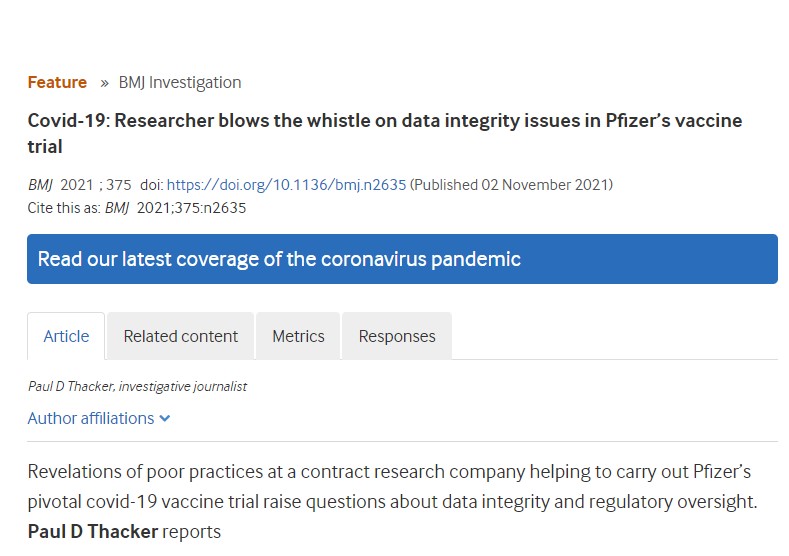
https://www.bmj.com/content/375/bmj.n2635
Feature BMJ Investigation: Covid-19: Researcher blows the whistle on data integrity issues in Pfizer’s vaccine trial
BMJ 2021; 375 doi: https://doi.org/10.1136/bmj.n2635 (Published 02 November 2021). Cite this as: BMJ 2021;375:n2635
https://onlinelibrary.wiley.com/doi/full/10.1002/mco2.95
https://onlinelibrary.wiley.com/doi/10.1002/mco2.90

_______________________
LINK S.MESSA/HOLY MASS: https://www.proselitismodellascienza.it/2021/11/11/vide-ergo-ne-lumen-quod-in-te-est-tenebrae-sint/?fbclid=IwAR3VGS8Sa38MqZCFitwenOWcYjYIAhj3lCwfIeY4qO980XU7sEAGu6swb44
Eccli 44:16-27; 45:3-20
Ecce sacérdos magnus, qui in diébus suis plácuit Deo, et invéntus est iustus: et in témpore iracúndiæ factus est reconciliátio.
Luc 11:33-36
In illo témpore: Dixit Iesus discípulis suis: Nemo lucérnam accéndit, et in abscóndito ponit, neque sub módio.
Oggi celebriamo la memoria di San Martino (in latino: Martínus, urbis Turónis Epíscopus; Sabaria, 316 circa – Candes, 8 novembre 397) primo santo non martire (percio’ detto confessore, ovvero ha testimoniato la sua fede con le parole e le azioni eroiche). Ha fondato il monachesimo in Occidente, l’odierna Francia, importandolo dal Medio Oriente (Egitto, Tebaide) e costituendo un monastero a Tours. E’ stato un vescovo cristiano del IV secolo. Originario della Pannonia, nell’odierna Ungheria, esercitò il suo ministero nella Gallia del tardo impero romano. È uno dei Santi più venerati in Occidente. Nato da genitori pagani, fu vescovo di Tours e condusse vita monastica in un cenobio da lui stesso fondato. Secondo la tradizione, quando era ancora soldato romano ma gia’ catecumeno (ma non ancora battezzato quindi), nel vedere un mendicante seminudo patire il freddo durante un acquazzone gli donò metà del suo mantello; poco dopo incontrò un altro mendicante e gli regalò l’altra metà: subito il cielo si schiarì e la temperatura si fece più mite.
Con questo gesto Martino aveva inteso fare la carita’ ai poveri.
Occorre avere carita’ verso gli altri, con un cuore attento alle necessita’ altrui. Oggi si chiama empatia. Ma la carita’ non e’ cieca. Va unita alla verita’ e il discernimento. Non si puo’ aiutare chiunque chiede anche per secondi fini o addirittura fini perversi [NDR, come realizzare un’invasione musulmana!]
Sia lodato Gesu’ Cristo! Sempre sia lodato!
____________________
(*) Questo commento e’ scritto in tempo reale durante l’omelia. Mi scuso per l’eventuale misinterpretazione delle parole di Don Enrico.
Eccli 44: 16-27; 45: 3-20 Ecce sacérdos magnus, here in diébus suis plácuit Deo, et invéntus est iustus: et in témpore iracúndiæ factus est reconciliátio.
Luke 11: 33-36 In illo témpore: Dixit Iesus discípulis suis: Nemo lucérnam accéndit, et in abscóndito ponit, neque sub módio.
Today we celebrate the memory of Saint Martin (in Latin: Martínus, urbis Turónis Epíscopus; Sabaria, c.316 – Candes, November 8, 397), the first non-martyr saint (therefore called confessor, or rather he testified to his faith with heroic words and actions ).
He founded monasticism in the West, today’s France, importing it from the Middle East (Egypt, Thebaid) and establishing a monastery in Tours. He was a Christian bishop of the fourth century.
Originally from Pannonia, in today’s Hungary, he exercised his ministry in Gaul during the late Roman Empire. He is one of the most revered saints in the West. Born of pagan parents, he was bishop of Tours and led a monastic life in a monastery he himself founded.
According to tradition, when he was still a Roman soldier but already a catechumen (but not yet baptized therefore), on seeing a half-naked beggar suffer the cold during a downpour he gave him half of his cloak; shortly after he met another beggar and gave him the other half: immediately the sky cleared and the temperature became milder.
With this gesture, Martin intended to give charity to the poor. It is necessary to have charity towards others, with a heart attentive to the needs of others. Today it is called empathy.
But charity is not blind. It must be combined with truth and discernment. You cannot help anyone who asks for ulterior motives or even perverse ends [Editor’s note, like carrying out a Muslim invasion!]
Praised be Jesus Christ! Always be praised!
________________
(**) This document is written in real time while the homily is taking place. I escuse myself for any possible misinterpretation of the words by Don Enrico.
Evangelium Luc 11:33-36
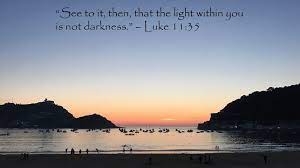
In illo témpore: Dixit Iesus discípulis suis: Nemo lucérnam accéndit, et in abscóndito ponit, neque sub módio: sed supra candelábrum, ut, qui ingrediúntur, lumen vídeant. Lucérna córporis tui est óculus tuus. Si óculus tuus fúerit simplex, totum corpus tuum lúcidum erit: si autem nequam fúerit, étiam corpus tuum tenebrósum erit. Vide ergo, ne lumen, quod in te est, ténebræ sint. Si ergo corpus tuum totum lúcidum fúerit, non habens áliquam partem tenebrárum, erit lúcidum totum, et sicut lucérna fulgóris illuminábit te.
Gospel Luke 11:33-36
At that time, Jesus said to His disciples, No one lights a lamp and puts it in a cellar or even under the measure, but upon the lamp-stand, that they who enter in may see the light. The lamp of your body is your eye. If your eye be sound, your whole body will be full of light. But if it be evil, your body also will be full of darkness. Take care, therefore, that the light that is in you is not darkness. If, then, your whole body is full of light, having no part in darkness, it will all be illumined, as when a bright lamp illumines you.
Eccli 44:16-27; 45:3-20
Ecce sacérdos magnus, qui in diébus suis plácuit Deo, et invéntus est iustus: et in témpore iracúndiæ factus est reconciliátio.
Luc 11:33-36
In illo témpore: Dixit Iesus discípulis suis: Nemo lucérnam accéndit, et in abscóndito ponit, neque sub módio.
Oggi celebriamo la memoria San Martino (in latino: Martínus, urbis Turónis Epíscopus; Sabaria, 316 circa – Candes, 8 novembre 397) primo santo non martire (percio’ detto confessore, ovvero ha testimoniato la sua fede con le parole e le azioni eroiche). Ha fondato il monachesimo in Occidente, l’odierna Francia, importandolo dal Medio Oriente (Egitto, Tebaide) e costituendo un monastero a Tours. E’ stato un vescovo cristiano del IV secolo. Originario della Pannonia, nell’odierna Ungheria, esercitò il suo ministero nella Gallia del tardo impero romano. È uno dei Santi più venerati in Occidente. Nato da genitori pagani, fu vescovo di Tours e condusse vita monastica in un cenobio da lui stesso fondato. Secondo la tradizione, quando era ancora soldato romano ma gia’ catecumeno (ma non ancora battezzato quindi), nel vedere un mendicante seminudo patire il freddo durante un acquazzone gli donò metà del suo mantello; poco dopo incontrò un altro mendicante e gli regalò l’altra metà: subito il cielo si schiarì e la temperatura si fece più mite.
Con questo gesto Martino aveva inteso fare la carita’ a i poveri.
Occorre avere carita’ verso gli altri, con un cuore attento alle necessita’ altrui. Oggi si chiama empatia. Ma la carita’ non e’ cieca. Va unita alla verita’ e il discernimento. Non si puo’ aiutare chiunque chiede anche per secondi fini o addirittura fini perversi [NDR, come realizzare un’invasione musulmana!]
Sia lodato Gesu’ Cristo! Sempre sia lodato!
____________________
(*) Questo commento e’ scritto in tempo reale durante l’omelia. Mi scuso per l’eventuale misinterpretazione delle parole di Don Enrico.
Eccli 44: 16-27; 45: 3-20 Ecce sacérdos magnus, here in diébus suis plácuit Deo, et invéntus est iustus: et in témpore iracúndiæ factus est reconciliátio.
Luke 11: 33-36 In illo témpore: Dixit Iesus discípulis suis: Nemo lucérnam accéndit, et in abscóndito ponit, neque sub módio.
Today we celebrate the memory of Saint Martin (in Latin: Martínus, urbis Turónis Epíscopus; Sabaria, c.316 – Candes, November 8, 397), the first non-martyr saint (therefore called confessor, or rather he testified to his faith with heroic words and actions ).
He founded monasticism in the West, today’s France, importing it from the Middle East (Egypt, Thebaid) and establishing a monastery in Tours. He was a Christian bishop of the fourth century.
Originally from Pannonia, in today’s Hungary, he exercised his ministry in Gaul during the late Roman Empire. He is one of the most revered saints in the West. Born of pagan parents, he was bishop of Tours and led a monastic life in a monastery he himself founded.
According to tradition, when he was still a Roman soldier but already a catechumen (but not yet baptized therefore), on seeing a half-naked beggar suffer the cold during a downpour he gave him half of his cloak; shortly after he met another beggar and gave him the other half: immediately the sky cleared and the temperature became milder.
With this gesture, Martin intended to give charity to the poor. It is necessary to have charity towards others, with a heart attentive to the needs of others. Today it is called empathy.
But charity is not blind. It must be combined with truth and discernment. You cannot help anyone who asks for ulterior motives or even perverse ends [Editor’s note, how to carry out a Muslim invasion!]
Praised be Jesus Christ! Always be praised!
________________
(**) This document is written in real time while the homily is taking place. I escuse myself for any possible misinterpretation of the words by Don Enrico.